
When there are no eggs in the house, most chocolate chip cookies either go flat or turn cakey. This recipe solves that problem by building the dough around condensed milk, which does three jobs at once: it sweetens the dough, it binds it, and it keeps the crumb soft for days. The result is a classic-style chocolate chip cookie with crisp edges, soft centres, and melted chocolate pockets, made in one bowl, with no eggs, no egg replacer, and no complicated method.
This is a fuller, classic-style version, not a four-ingredient shortcut. Much like our 4-ingredient condensed milk chocolate chip cookies and our crispy edges, chewy centre chocolate chip cookies, this batch starts from one bowl and a hot oven, but here the dough is built like a traditional chocolate chip cookie, with all-purpose flour, brown sugar, and a proper cookie structure.
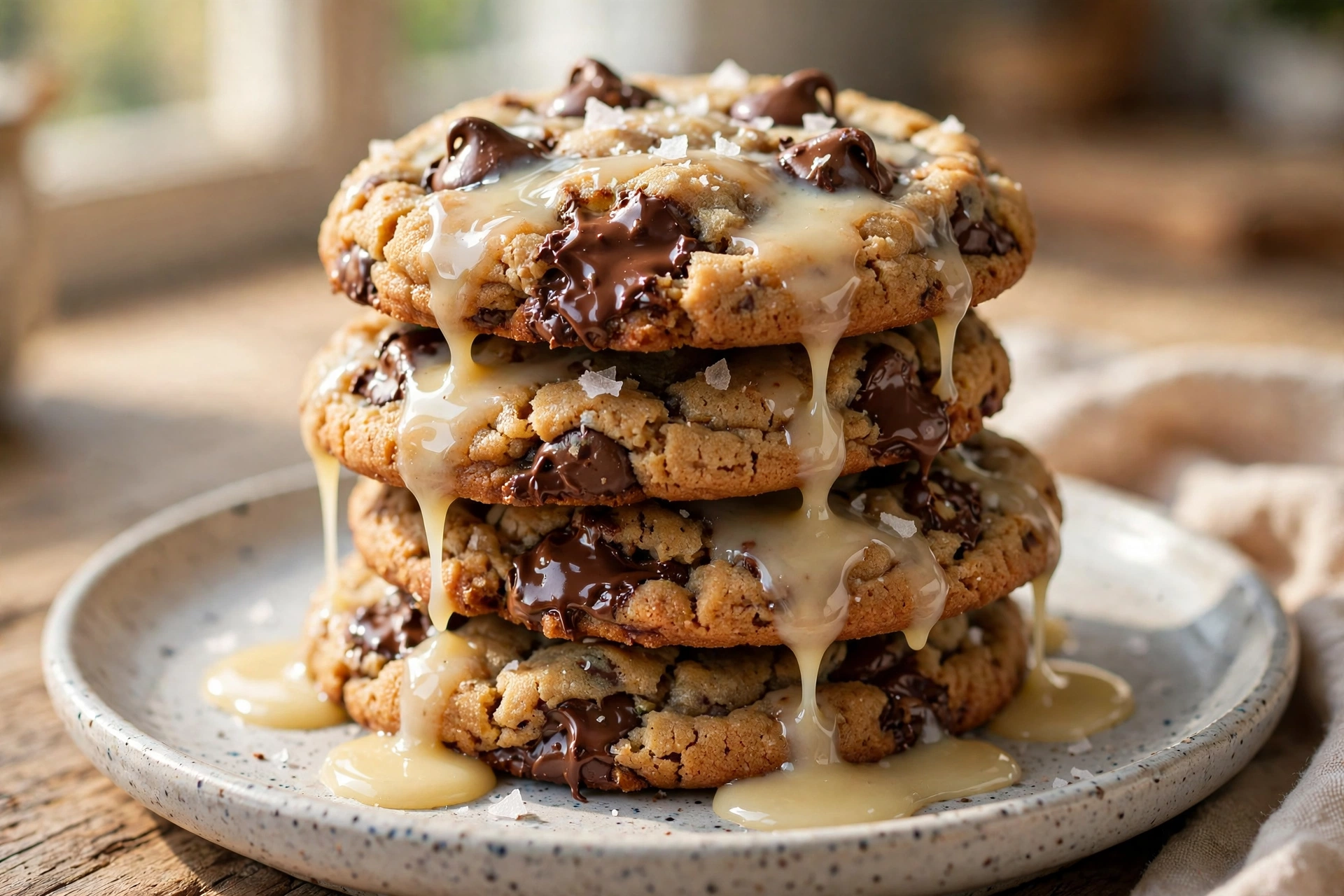
How Eggless Chocolate Chip Cookies With Condensed Milk Stay Chewy
Condensed milk is not just a sweetener here. It is the egg replacement in this recipe, and it works because it is a concentrated source of milk proteins, milk fat, and sugar. Those proteins set in the oven, much like egg proteins do, and they help the dough hold together, so the cookies bake into rounds instead of crumbling. The sugar in the condensed milk also helps the cookies brown, while the fat keeps the crumb moist. Without it, the dough would be dry and crumbly, and the cookies would not hold their shape.
Cornstarch is the second piece of this puzzle. It is a pure starch with no protein, so it dilutes the gluten in the flour and softens the crumb without adding flavour. That softening effect is what keeps the centres tender, even when the edges are crisp, and it also helps the cookies hold their shape in the tin. Without cornstarch, the centres would be tougher and more bread-like, and the batch would lose its signature soft-centre, crisp-edge contrast. Cornstarch also helps the cookies stay soft for days, because it holds moisture in the crumb, which is why this batch does not go stale as quickly as a traditional egg cookie.
The third piece is the combination of brown sugar and separately measured leaveners. Brown sugar adds moisture and a caramel note, and because it is hygroscopic, it pulls moisture from the air and keeps the cookies soft. Baking powder and baking soda are measured separately in this recipe, at 1 teaspoon and 1/2 teaspoon, because they do different jobs: baking powder lifts the dough, while baking soda helps it spread just enough and brown in the oven. Together, they give a controlled rise and a chewy centre, without the puffy, cakey texture that comes from too much leavening.
Why This Eggless Chocolate Chip Cookie Batch Works So Well
- Truly Eggless, Still Chewy: Condensed milk replaces the egg, so these cookies work for egg allergies and empty fridges, without a flax egg, a chia egg, or a shop-bought replacer. The condensed milk also supplies moisture, so the centres stay soft long after the cookies cool.
- Balanced Texture: Crisp edges, soft centres, and melted chocolate pockets come from a simple balance: brown sugar and a hot oven set the outside, while condensed milk, cornstarch, and a short bake keep the inside tender.
- Simple to Make: Mix everything with a spatula or wooden spoon. No mixer is needed, no chilling is required, and the dough is forgiving, so this is a good first eggless cookie to bake.
- Great for Sharing: Twenty cookies from one bowl is enough for a class party, a work bake sale, or a weekend tin, and the batch freezes well, so you can bake ahead and store extras for later.
What Each Ingredient Does in This Eggless Cookie Dough
Because this dough has no egg to hide behind, each ingredient has to earn its place. Change one of them and the cookies will tell you. That is why this recipe uses grams as well as cups and tablespoons: in an egg-free dough, the balance between flour, sugar, and liquid is much tighter than in a traditional dough.
1. Unsalted Butter, Softened (115g / 1/2 Cup)
Butter should be soft enough to dent with a finger, but not greasy or melted. If it is too warm, the cookies will spread too far. If it is straight from the fridge, it will not cream properly with the condensed milk. Use unsalted butter, softened, so you can control the salt. Salted butter works in a pinch, but leave out the added salt in step 4. Precision Tip: For a stronger butter flavour, use a good-quality, full-fat butter with a high fat content, as this gives a richer cookie.
2. Light Brown Sugar (50g / 1/4 Cup, Packed)
Brown sugar is used here in a smaller amount than in a traditional cookie, at 50g, because the condensed milk already brings a lot of sweetness. Using 100g of brown sugar, as many condensed milk recipes do, makes the dough too sweet and too wet. Half that amount keeps the caramel note, while leaving room for crisp edges. Pack the brown sugar into your measuring cup, or weigh it, for the most accurate result, as loose brown sugar can vary by up to 10g.
3. Sweetened Condensed Milk (200g / 2/3 Cup)
Condensed milk is the egg replacement and a major sweetener in this recipe, so it must be measured accurately. This recipe uses 200g of condensed milk, which is about 2/3 cup. If you use less, the cookies will be dry and crumbly. If you use more, the cookies will spread too far and the centres will be too wet. Always use full-fat sweetened condensed milk, not evaporated milk, which is thin, unsweetened, and will not bind the dough in the same way.
4. Vanilla Extract (1 Teaspoon) and Fine Salt (1/4 Teaspoon)
Vanilla rounds out the milky sweetness of the condensed milk and adds warmth to the cookie. Use real vanilla extract, not imitation, if you can, as it gives a cleaner flavour. Fine salt is used here, rather than flaky salt, because it dissolves evenly into the dough. The 1/4 teaspoon of salt balances the sweetness and brings out the chocolate flavour, without making the cookies taste salty.
5. All-Purpose Flour (260g / 2 Cups + 2 Tablespoons, Spooned and Levelled)
All-purpose flour, measured separately from the leaveners, gives this dough its structure. If you use too much flour, the cookies will be dry and cakey. If you use too little, the cookies will spread too far. Spoon the flour into your measuring cup and level it off with the back of a knife, or weigh it, for 260g of flour, which is 2 cups + 2 tablespoons. Do not swap in self-rising flour, which already contains baking powder and salt, or the cookies will puff up, then collapse.
6. Cornstarch (1 Tablespoon), Baking Powder (1 Teaspoon), and Baking Soda (1/2 Teaspoon)
Cornstarch softens the crumb and adds chew, as explained above, but it only works in the right amount. This recipe uses 1 tablespoon of cornstarch, not 2, because more than that makes the cookies too soft and doughy. Baking powder and baking soda are measured separately, at 1 teaspoon and 1/2 teaspoon, because they do different jobs: baking powder lifts the dough, while baking soda helps it spread and brown. Using only baking soda, as some condensed milk recipes do, gives a flatter, more spread-out cookie, so this recipe uses both leaveners for a controlled rise.
7. Semi-Sweet Chocolate Chips (150g / 1 Cup) and Flaky Salt (Optional)
Semi-sweet chocolate chips provide a bitter contrast to the sweet dough, so use semi-sweet, not milk chocolate, which will make the cookies too sweet. This recipe uses 150g of chocolate chips, which is about 1 cup, and reserves a small handful for the tops. Flaky salt is optional, but it adds a lovely sweet-salty finish when sprinkled on the warm cookies as soon as they come out of the oven.
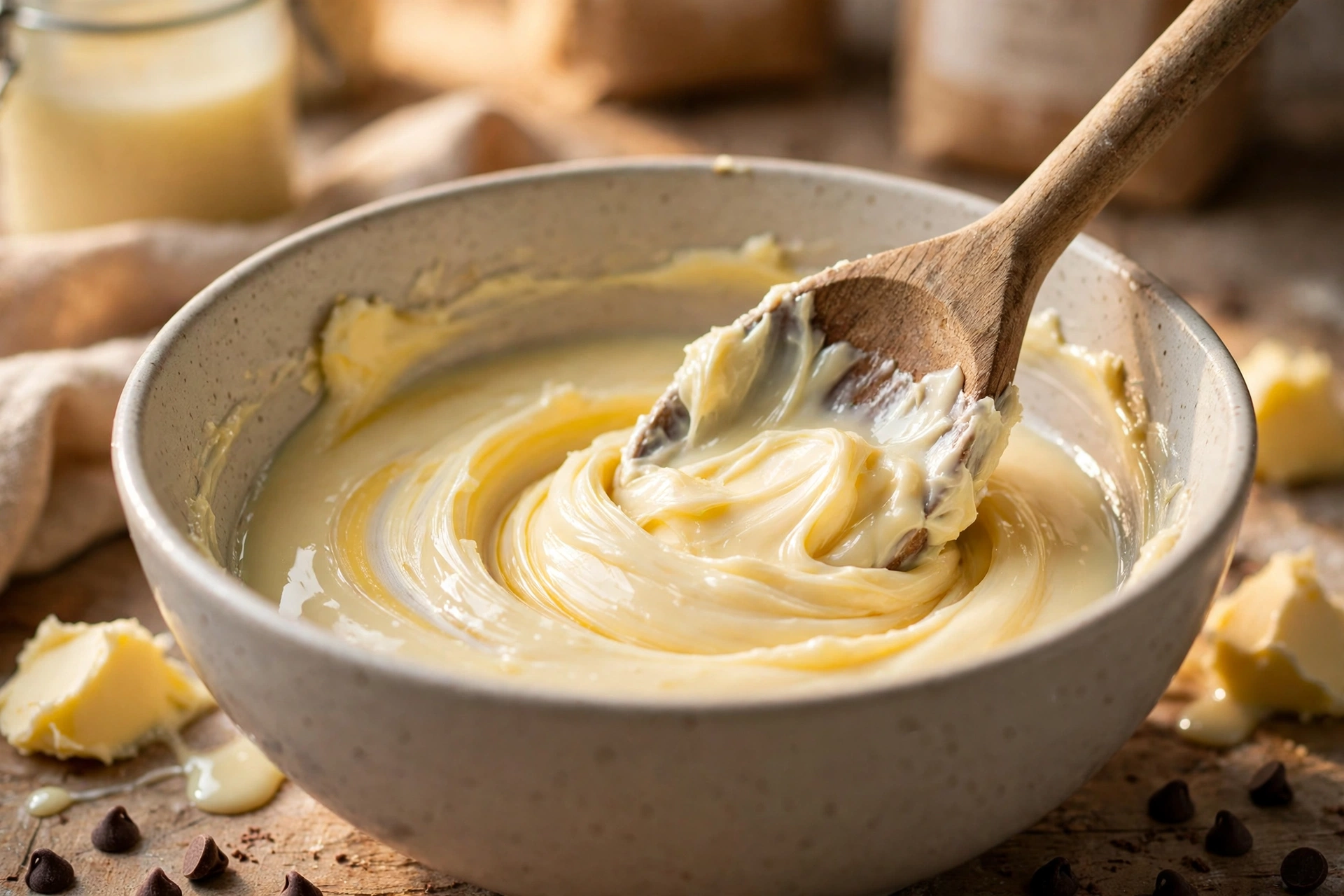
How to Make Eggless Chocolate Chip Cookies With Condensed Milk, Step by Step
1. Preheat the Oven and Prepare the Trays
Position your oven racks in the centre and top-third positions of the oven. Preheat the oven to 350°F (175°C). Line two baking trays with parchment paper, then set them aside. Position your oven racks so the cookies are not too close to the top or bottom elements. The top tray will bake a little faster than the bottom one, so you will need to swap trays halfway through baking. Preheating your oven for at least 15 minutes ensures a consistent bake.
2. Cream the Butter, Sugar, and Condensed Milk
Place the softened butter, brown sugar, condensed milk, and vanilla in a large bowl. Cream them together with a spatula or wooden spoon for 1 to 2 minutes, until the mixture is smooth, thick, and slightly paler in colour. Do not over-cream, or the cookies will spread too far. The mixture should look like a thick, sweet buttercream, not a thin batter. If your butter is too cold, let the mixture sit for 5 minutes, then stir again.
3. Combine the Dry Ingredients
Whisk the flour, cornstarch, baking powder, baking soda, and salt in a separate bowl, then fold them into the butter mixture in two additions, stirring gently for 20 to 30 seconds after each addition, until the last white streak disappears. Do not overmix, or the cookies will be tough and cakey. The dough will look soft and slightly sticky, but it should hold together when scooped. If it looks dry, you may have over-measured the flour.
4. Fold in the Chocolate Chips
Fold in the chocolate chips with just a few strokes, reserving a small handful for the tops. Do not overmix at this stage, or the cookies will be tough. The chocolate chips should be evenly distributed through the dough, with a few visible on the surface. If you are using flaky salt, do not add it yet, as it goes on the warm cookies after baking.
5. Scoop the Dough and Space the Cookies
Scoop the dough into balls of about 2 tablespoons each, using a cookie scoop or two spoons, and place them on the prepared trays, leaving 2 inches between each ball. Do not flatten the balls, as they will spread in the oven. Press the reserved chocolate chips into the tops of the balls, so the cookies look bakery-style when they come out of the oven. You should get 20 cookies from this batch, with 10 on each tray.
6. Bake One Tray at a Time
Bake one tray at a time at 350°F (175°C) for 11 to 13 minutes, until the edges are set and lightly golden, but the centres still look soft and slightly underdone. If you are baking two trays at once, swap them halfway through, so the cookies bake evenly. Do not bake until the centres look done, or the cookies will be dry. The cookies will continue to cook on the tray, so the pan rest is part of the baking time.
7. Rest the Cookies and Cool Them Completely
Remove the tray from the oven and let the cookies rest on the tray for 10 minutes. During this time, the centres will set, and the cookies will firm up enough to move. If you want a sweet-salty finish, sprinkle the warm cookies with flaky salt now. Transfer the cookies to a wire rack and cool them completely before storing, as warm cookies in a closed container will go soft and lose their edges.
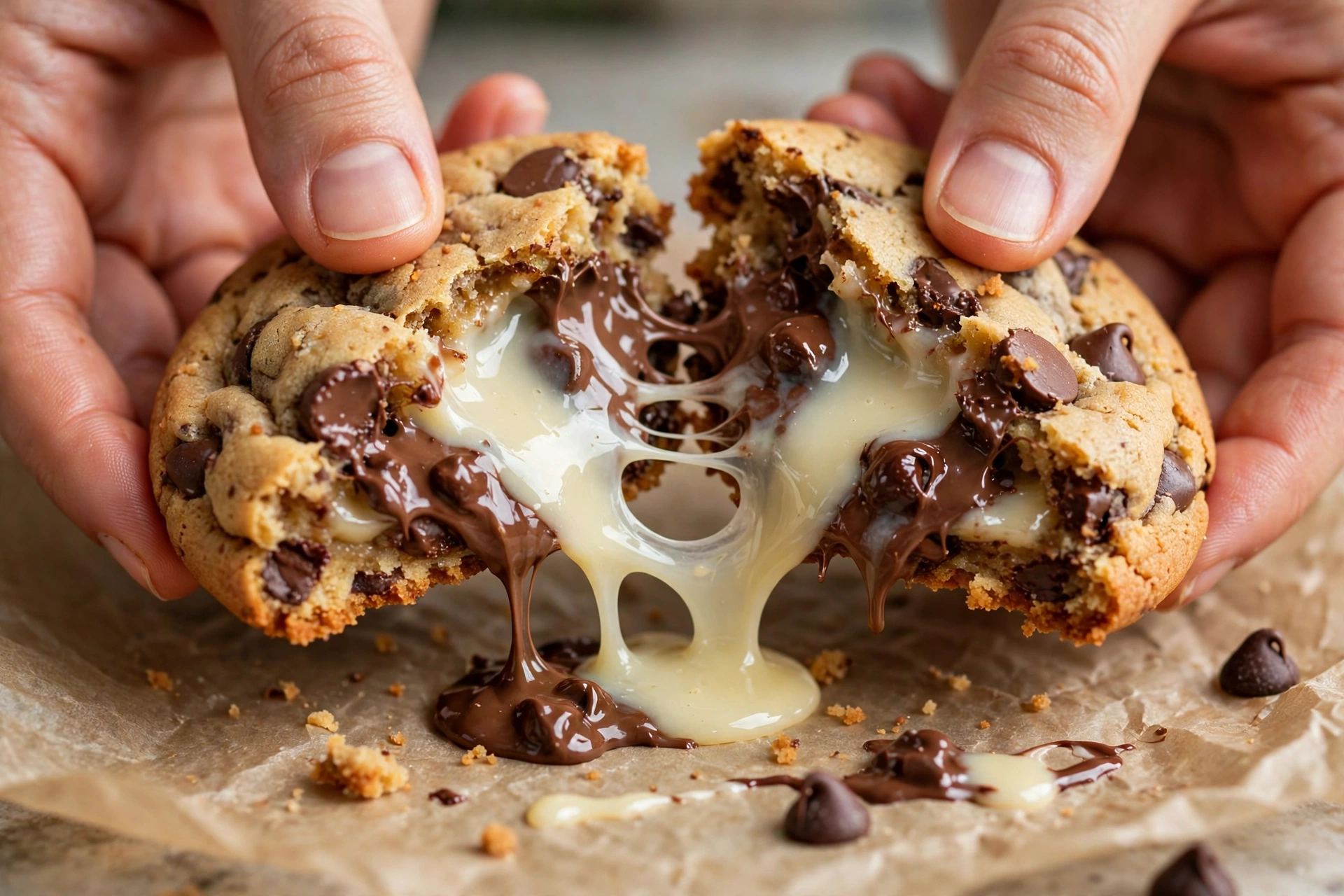
4 Mistakes That Ruin Eggless Chocolate Chip Cookies
Because this dough has no egg to set it firmly, small mistakes show up more clearly than they do in a traditional dough. The batch will still taste good, but the texture will suffer. A cookie with the wrong flour or a heavy hand with the milk will tell you the next day, so this section is worth a read.
1. Too Much Condensed Milk
The most common mistake in any condensed milk cookie is to assume more is better. It is not. This recipe uses 200g of condensed milk, which is enough to replace the egg, sweeten the dough, and keep the crumb moist. If you pour in extra milk, or if you accidentally measure 2/3 cup after the milk has settled, the dough becomes sticky, hard to scoop, and the cookies spread into thin, lace-like rounds. If your dough looks wet and slack, you have probably used too much condensed milk.
2. Using Self-Rising Flour
Self-rising flour already contains baking powder and salt, so using it here will over-leaven the dough and make the cookies puff up, then collapse. This recipe is built around all-purpose flour, plus 1 tablespoon of cornstarch, 1 teaspoon of baking powder, and 1/2 teaspoon of baking soda, measured separately. That combination gives a controlled rise and a chewy centre. If self-rising flour is all you have, this recipe is not the one to use it in.
3. Over-Measuring the Flour
Scooping flour straight from the bag packs it down and can add up to 30g extra flour to your dough. In a recipe with no egg to soften the crumb, that is enough to turn the cookies dry and cakey. Instead, spoon the flour into your measuring cup and level it off with the back of a knife, or weigh it, for 260g of flour, which is 2 cups + 2 tablespoons. If you have a kitchen scale, use it for every ingredient in this recipe, because precision makes a bigger difference here than in a traditional dough.
4. Baking Until the Centres Look Done
The most common reason these cookies turn dry is that they are baked until they look ready. By the time the centres look set in the oven, they will be overbaked, because the cookies keep cooking on the tray. Remove them when the edges are set and lightly golden, but the centres still look soft and slightly underdone. They will set as they rest, and the pan rest, not the oven, is what finishes the cookie.
4 Easy Variations on This Eggless Chocolate Chip Cookie Recipe
Once you have the base recipe working, these variations keep the same structure but change the flavour. Each one swaps only a small part of the dough, without changing the flour, sugar, or condensed milk balance, so the cookies will still spread, rest, and set in the same way.
- Double Chocolate Version: Replace 30g of the flour with 30g of cocoa powder for a darker, more intense cookie. Keep the cornstarch, baking powder, and baking soda the same, and use 150g of chocolate chips as usual.
- Nut Crunch Version: Fold 80g of chopped walnuts or pecans into the dough with the chocolate chips, or press a few chopped nuts onto the tops before baking. Reduce the chocolate chips to 100g if you want the nuts to stand out.
- Salted Caramel Version: Press a soft caramel square into the centre of each dough ball before baking, and sprinkle the warm cookies with flaky salt as soon as they come out of the oven. The caramel will melt into the centre, so keep the pan rest to 10 minutes.
- Oat Chocolate Chip Version: Replace 50g of the flour with 50g of rolled oats for a chewier, more rustic cookie. The oats absorb a little moisture, so the cookies may need an extra minute in the oven, but they will stay soft in the centre.
How to Store and Freeze These Cookies
Because these cookies are made with condensed milk and brown sugar, they store better than most butter cookies, as long as you keep them airtight and do not store them while warm.
Room Temperature Storage
Store fully cooled cookies in an airtight container at room temperature for up to 5 days. Place a sheet of parchment between layers so the chocolate does not stick the cookies together. Unlike traditional cookies that harden after two days, these cookies stay soft because condensed milk holds moisture. Do not store them in the fridge for everyday eating, or they will firm up and taste dry until they return to room temperature.
Freezing Baked Cookies
Place cooled cookies in a single layer in a freezer-safe container or zip-top bag, with parchment between layers, and freeze for up to 3 months. Thaw at room temperature for 20 to 30 minutes before serving, or warm them in a low oven for 3 to 4 minutes. Thawed cookies will be a little softer than fresh ones, but still chewy.
Freezing Scooped Dough
Scoop the dough into balls, freeze them on a tray until solid, then transfer to a freezer-safe bag or container and freeze for up to 3 months. Bake straight from frozen, without thawing, at 350°F (175°C), adding 2 minutes to the baking time. Press reserved chocolate chips into the tops before baking, and keep the pan rest to 10 minutes.
Frequently Asked Questions About These Cookies
How is this different from the 4-ingredient condensed milk cookies already on the site?
The four-ingredient post is a shortcut: butter, condensed milk, self-rising flour, and chips, baked into 12 to 14 puffy, shortbread-style cookies. This post is a full, classic-style recipe: all-purpose flour with separately measured baking powder, baking soda, and cornstarch, plus brown sugar and vanilla, baked into 20 chewy cookies with crisp edges and soft centres. Same egg-free idea, different dough, different batch size, and different texture, so they are two different recipes, not two versions of the same one.
Can I use evaporated milk instead of condensed milk?
No. Evaporated milk is unsweetened and thin, so it cannot replace condensed milk in this recipe. It will not sweeten the dough, it will not bind the dough in the same way, and it will not hold moisture in the crumb. If you use evaporated milk, you will need to add extra sugar and a different binder, and the texture will not be the same. Always use full-fat sweetened condensed milk for these cookies.
Why did my cookies spread flat without eggs?
Flat cookies usually come from one of three things: butter that was too warm, flour that was under-measured, or an oven that was not fully preheated. Soft butter and a hot oven are the most common causes, because the fat melts before the dough sets. Check that your butter is soft, not melted, that you measured 260g of flour, and that your oven has been preheating for at least 15 minutes. If the dough still feels soft, chill the scooped dough for 10 minutes before baking, which helps the cookies hold their shape.
Eggless Chocolate Chip Cookies With Condensed Milk
Bake chewy, classic-style eggless cookies with crisp edges and soft centres, made with condensed milk instead of eggs, in 37 minutes total.
Ingredients
Click items to check off as you bake.Baker's Secret: Use full-fat sweetened condensed milk, never evaporated milk, and spoon and level, or weigh, the all-purpose flour. Those two choices decide whether the batch stays chewy or turns dry.
Step-by-Step Instructions
Follow these steps in order for the best result.- 1Preheat & Prep Trays: Preheat oven to 350°F (175°C). Line two trays with parchment paper, ungreased.
- 2Cream Wet Base: Stir softened butter, brown sugar, condensed milk, and vanilla for 1 to 2 minutes, until smooth and thick.
- 3Fold in Flour: Fold in flour, cornstarch, baking powder, baking soda, and salt gently for 20 to 30 seconds, until the last white streak disappears.
- 4Add Chocolate: Fold in chocolate chips with a few strokes, reserving a handful for the tops.
- 5Scoop & Top: Scoop 2-tablespoon balls, press reserved chips into the tops, add flaky salt if using, and space 2 inches apart, unflattened.
- 6Bake: Bake one tray at a time at 350°F (175°C) for 11 to 13 minutes, until edges are set and centres are soft.
- 7Rest & Cool: Rest on the tray for 10 minutes, then transfer to a wire rack and cool completely before storing.