
One visa, 29 countries: that is the promise of the Schengen visa, and it is why so many travellers dream of a trip to Europe. How to get a Schengen visa is really a question about choosing the right country to apply to and preparing your documents properly. There is no single "Schengen embassy" — you apply at the consulate of the country where you will spend the most time, submit your documents and fingerprints at a visa application centre, and if the visa is granted, the same sticker in your passport lets you travel across the whole Schengen Area.
This guide walks through the whole process in order, for applicants applying from outside the Schengen Area: what the Schengen Area is, which country's consulate you must apply to, every document you need, what it costs, how long it takes, how long you can stay, and the mistakes that get applications refused. All figures were checked against the European Commission on 5 November 2026, and the official sources are linked at the end, because visa fees and rules change and the official pages always win over any guide.

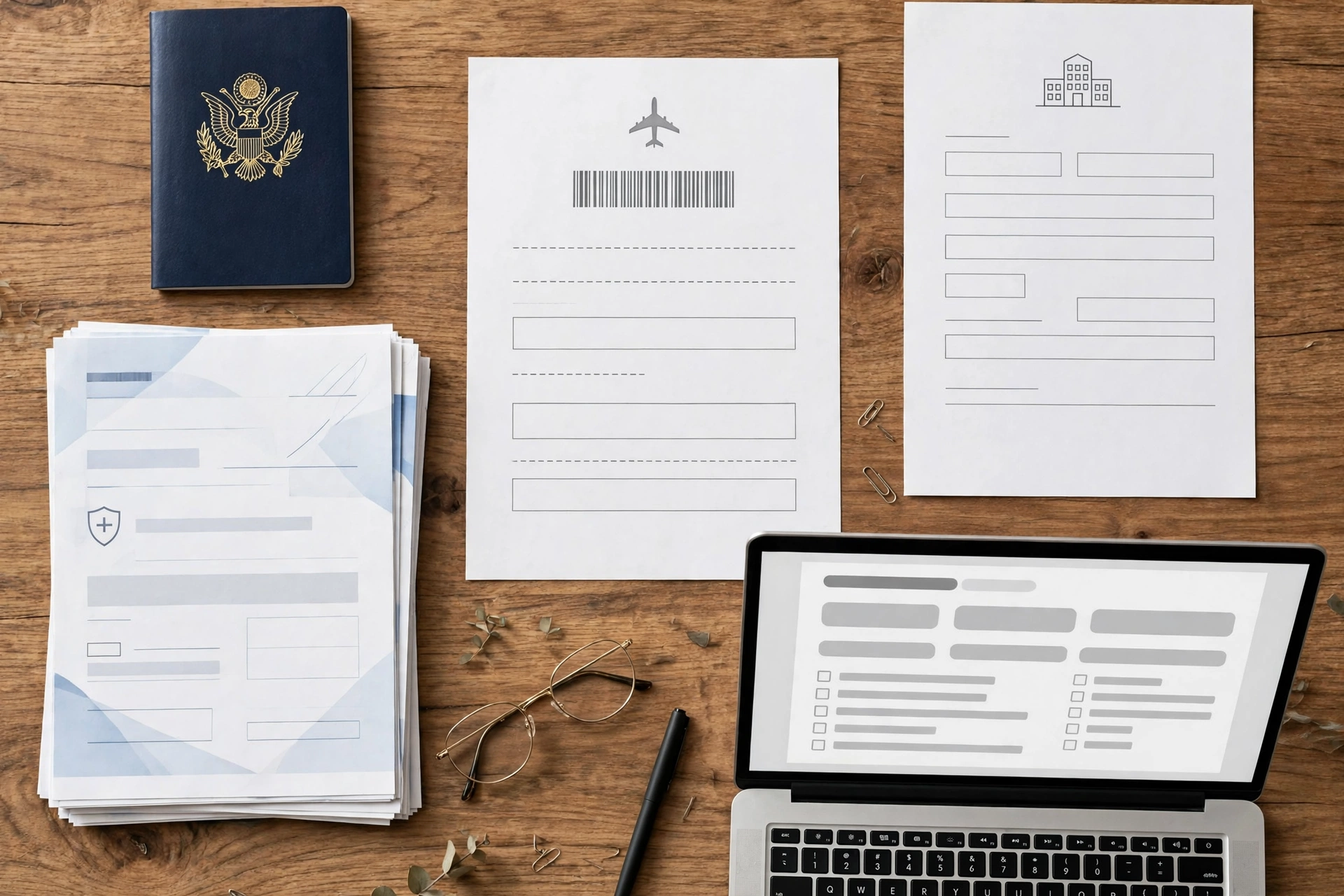
Required Documents — Schengen Visa Checklist
Gather every item below before you book your appointment. Missing or weak documents are the most common cause of delay and refusal, and the consulate will not hold your place in the queue while you find them. Every consulate has its own checklist, so always compare this list with the checklist on your destination country's VFS Global page before you go.
| Document | What it must show |
|---|---|
| 1. Valid passport | Issued within the last 10 years, valid for at least 3 months after your planned departure from the Schengen Area, with at least 2 blank pages. Bring your old passports too, with copies of previous visas. |
| 2. Completed Schengen visa application form | The form for your destination country, filled in completely and signed. Most countries have an online form you print and sign. |
| 3. Passport photographs | Two recent photos, 35 × 45 mm, white background, meeting ICAO standards, taken within the last 6 months. |
| 4. Travel medical insurance — at least €30,000 | A policy covering emergency medical care, hospitalisation and repatriation (including in the event of death), valid for the whole Schengen Area and the full length of your stay. Buy it from a provider on the list your consulate accepts. |
| 5. Proof of funds — bank statements | Personal bank statements for the last 3 to 6 months, original and bank-stamped, showing regular income and enough money to cover the trip. Salary slips and a bank balance confirmation letter help. There is no single EU-wide amount — each country sets its own daily reference amount. |
| 6. Proof of accommodation | Hotel bookings covering the whole stay, or a formal invitation from a host in the Schengen Area if you are staying with family or friends. |
| 7. Flight itinerary | A flight reservation showing your planned dates in and out of the Schengen Area. Do not buy a non-refundable ticket before your visa is approved — a reservation is enough. |
| 8. Employment or business proof | If employed: a letter from your employer stating your position, salary and approved leave, plus a No Objection Certificate (NOC) and recent salary slips. If self-employed: business registration and tax returns. |
| 9. Cover letter and travel plan | A short letter explaining why you are travelling, your day-by-day itinerary, who is paying, and why you will return to your home country — your job, family and other ties at home. |
| 10. Family and identity documents | Your national identity card, and a family registration certificate in English if your country issues one. Birth and marriage certificates where relevant. Any document not in English needs a certified English translation. |
At a glance: visa fee €90 for adults, €45 for children aged 6 to 12, free for children under 6 · travel insurance minimum €30,000 · decision normally within 15 calendar days (can extend to 45 days) · apply no earlier than 6 months and at least 15 days before travel · stay up to 90 days in any 180-day period.
What Is a Schengen Visa?
A Schengen visa is an entry permit for non-EU nationals to make a short, temporary visit of up to 90 days in any 180-day period to a country in the Schengen Area. The Schengen Area is a group of 29 European countries that have abolished border controls between themselves, so once you are inside, you can travel from one to another without showing your passport at every border. The 29 countries are Austria, Belgium, Bulgaria, Croatia, Czechia, Denmark, Estonia, Finland, France, Germany, Greece, Hungary, Iceland, Italy, Latvia, Liechtenstein, Lithuania, Luxembourg, Malta, the Netherlands, Norway, Poland, Portugal, Romania, Slovakia, Slovenia, Spain, Sweden, Switzerland and — note — the United Kingdom and Ireland are not in the Schengen Area, and Cyprus is not either. A Schengen visa does not let you enter the UK or Ireland; those need their own visas.
The visa most travellers apply for is the short-stay visa, often called a Type C visa. It covers tourism, visiting family or friends, and short business trips. Schengen visas come in three forms: a single-entry visa, which allows you to enter the Schengen Area once; a multiple-entry visa, which allows several visits for as long as the visa is valid; and an airport transit visa, which only allows you to connect through the international transit area of an airport during a stopover. If your nationality is on the EU list of countries whose citizens need a visa, you need a Schengen visa to visit; there is no visa-free entry and no e-visa for ordinary passports from those countries.
It is important to understand what this visa does not do. It does not let you work in Europe, and it does not let you stay longer than 90 days in any 180-day period. If you want to work, study for a long course, or live in a European country, you need a long-stay national visa (Type D) from that specific country — see the section near the end of this guide. And the 90 days is a rolling limit, not a fixed 6-month block: the European Commission's short-stay calculator looks backwards over a moving 180-day window from each day of your stay, so every trip you take counts towards the same 90 days.
Which Country's Consulate Should You Apply To?
This is the decision that trips up more first-time applicants than any other, and it matters because applying to the wrong consulate is a common reason for refusal. There is no single "Schengen embassy". The European Commission's rule is simple: you must lodge your application at the consulate of the country you intend to visit. If you are visiting more than one Schengen country, apply at the consulate of the country where you will spend the longest time. If you will spend the same number of days in several countries, apply at the consulate of the first country you will visit. So 7 days in France and 3 in Italy means you apply to France. Make your itinerary match your application: the consulate checks your hotel bookings and flight against the country you applied to.
In most countries, almost all Schengen applications go through VFS Global, the visa application centre that collects applications on behalf of the consulates. Each destination country has its own VFS Global page for your country, with its own checklist, appointment system and service fee. The consulate — not VFS — makes the decision on your visa. Never pay an agent who promises a guaranteed visa or claims to have an inside contact at a consulate; no agent can guarantee an approval, and paying for a fake hotel booking or a fake bank statement will get you refused and can get you banned.
Who Needs a Schengen Visa, and When to Apply
Citizens of certain non-EU countries must hold a short-stay visa when travelling to the Schengen Area. The European Commission publishes the full list of countries whose citizens need a visa to cross the EU's external borders. If you hold a passport from a country on that list, you need the visa even for a one-day trip.
Timing is part of the application, and the European Commission sets a clear window: you must submit your application at least 15 days before your intended journey, and no earlier than 6 months beforehand. Applying earlier than 6 months is not allowed, and applying later than 15 days before travel is a gamble — the normal processing time is 15 days, so a late application may simply not be decided in time. In practice, apply 4 to 8 weeks before your trip, and book your VFS appointment early, because slots at the visa application centres can be scarce in peak travel season.
How to Apply, Step by Step
Step 1: Choose Your Main Destination and Read Its Checklist
Decide your itinerary first, then work out your main destination using the rule above: longest stay wins, and equal stays go to the country you enter first. Go to that country's VFS Global page for your country and download its document checklist. Every country has small differences — some want 3 months of bank statements, others want 6 — and the checklist on the VFS page is the one that counts for your application.
Step 2: Fill In the Application Form
Complete the Schengen visa application form for your destination country. Most countries now have an online form that you fill in, print and sign. Answer every question honestly and exactly as your documents show it: your name exactly as it appears in your passport, your travel dates exactly as your flight reservation and hotel bookings show them, and your employment details exactly as your employer's letter states them. A form that contradicts its own supporting documents is one of the most common refusal reasons.
Step 3: Buy Your Travel Insurance
Buy a travel medical insurance policy that covers at least €30,000 for emergency medical care, hospitalisation and repatriation, valid for the whole Schengen Area and the full length of your stay. Buy it from a provider on the list your consulate accepts — some consulates only accept insurers from an agreed list, so check before you pay.
Step 4: Gather Your Documents and Book Your Appointment
Collect every document in the checklist at the top of this article, in the order your consulate's checklist lists them, on A4 paper, with certified English translations for anything not in English. Book your appointment online on the VFS Global page for your destination country, choosing the centre nearest you. Print your appointment confirmation and bring it with you.
Step 5: Attend Your Appointment and Give Biometrics
Go to the VFS Global centre on your appointment day with your passport, your form, your documents and the visa fee. Your fingerprints will be collected when you submit your application — this is standard for Schengen visas, and the biometrics you give are normally valid for 5 years. You will also pay the visa fee at the centre, usually in local currency at the consulate's exchange rate, plus the VFS service fee. The fee is non-refundable, even if your visa is refused.
Step 6: Wait for the Decision
The normal processing time for a Schengen visa application is 15 calendar days from the day your application reaches the consulate. That period can be extended to up to 45 days if a more detailed examination of your application or additional documents are required. Do not book non-refundable travel while you wait, and do not call the consulate for updates in the first 15 days — it will not speed anything up.
Step 7: Collect Your Passport and Check the Visa Sticker
When your passport is ready, VFS will tell you to collect it or send it by courier if you chose that service. Check the visa sticker the moment you get it back: your name, the dates, the number of entries (single or multiple), and the number of days allowed. If anything is wrong, tell the centre immediately.

How Much Does a Schengen Visa Cost?
There are three costs to budget for: the visa fee itself, the visa centre's service fee, and your travel insurance. The visa fee is set at EU level and is the same whichever Schengen country you apply to. The figures below are from the European Commission, checked on 5 November 2026. Fees change — the adult fee rose from €80 to €90 in June 2024 — so always confirm the current amounts on the official VFS Global page for your destination country before you pay.
| Cost | Amount (per person) |
|---|---|
| Visa fee — adults (12 years and over) | €90 |
| Visa fee — children aged 6 to 12 | €45 |
| Visa fee — children under 6 | Free |
| Visa fee — applicants from Armenia, Azerbaijan and Belarus | €35 (visa facilitation agreement) |
| VFS Global service fee | An additional fee applies if you apply through a visa service centre — the amount differs by country, so check the current amount on the VFS page for your destination before your appointment |
| Travel medical insurance | Varies by provider and trip length; the policy must cover at least €30,000 |
The visa fee can be waived for specific categories of applicants — for example, family members of EU or EEA citizens are eligible for a free and accelerated procedure under the Free Movement Directive — but ordinary tourist and family-visit applicants should budget for the full €90 per adult plus the service fee. The fee is paid in local currency at the consulate's exchange rate at the time of application, and it is non-refundable whether the visa is granted or refused.
Proof of Funds and Accommodation
Of all the documents, proof of funds causes the most refusals, and it is also the one where there is no single number to aim for. The European Commission requires evidence of financial means, but there is no single EU-wide amount: each Schengen country sets its own daily reference amount for visitors, and the consulate checks whether your money is enough for your specific trip.
That is why bank statements matter more than a single big deposit. Consulates typically ask for personal bank statements for the last 3 to 6 months, original and bank-stamped, with salary credits visible, plus a balance confirmation letter from the bank. A large lump sum deposited a week before the application, with no history behind it, is a classic red flag — officers read it as borrowed money that will leave the account the day after the visa is issued. Keep your account active and consistent for months before you apply, keep your salary slips, and if you are self-employed, bring your business registration and tax returns as well.
Accommodation works the same way: the consulate wants to see where you will sleep every night of your trip. Hotel bookings covering the whole stay are the simplest proof, and refundable bookings are fine — do not pay for non-refundable hotels before your visa is approved. If you are staying with family or friends, you will usually need a formal invitation from your host. Your accommodation must match your itinerary day by day: a hotel in Paris while your itinerary says you are in Rome that night is the kind of mismatch that gets an application refused.
How Long Can You Stay? The 90/180-Day Rule
A Schengen short-stay visa allows a visit of up to 90 days in any 180-day period. That sounds simple, and it is — until you take a second trip. The 180 days is a moving window, not a calendar half-year: on any day you are in the Schengen Area, you count back 180 days and add up all the days you have spent there in that window. If the total is 90 or more, you must leave. The European Commission provides a short-stay calculator to help you work it out, and it is worth using before you book a second trip.
A practical example makes it clear. If you spend 30 days in Europe in January, you have 60 days left in the 180 days that follow. If you return in April for another 30 days, you have 30 days left. But by July, the January days start falling out of the 180-day window, and your allowance grows again. Overstaying — even by one day — is recorded and can damage every future visa application you make. Keep your own count, and never rely on the number of days printed on a single visa sticker as your total allowance: the sticker's validity period and the 90/180 rule are two different limits, and both apply.
Multiple-entry visas are worth asking about if you travel often. A multiple-entry visa allows several visits to the Schengen Area for as long as the visa is valid, and consulates often give them to applicants with a clean travel history — previous Schengen visas used correctly, on time and without overstaying. First-time applicants usually receive a single-entry visa valid only for the dates of their trip. Each successful, well-used visa makes the next application stronger.
Long-Stay National Visas (Type D), Briefly
If your plans go beyond a short visit, the Type C visa is the wrong tool. A long-stay national visa — known as a Type D visa — is issued by one specific Schengen country for stays longer than 90 days, for purposes such as work, a long study course, family reunion or retirement. Each country has its own rules, fees and application process for national visas. A Type D visa also usually lets you travel to other Schengen countries for up to 90 days in any 180-day period, on top of your stay in the issuing country. If you are offered a job in Germany, a place at a university in France, or a family reunion in Italy, apply for that country's national visa directly through its embassy — do not try to stretch a tourist visa into a long stay, because that is an overstay and it will be recorded.
Common Reasons Schengen Visa Applications Are Refused
Most refusals are not bad luck — they are paperwork problems that could have been avoided. The most common ones are: applying to the wrong country's consulate, so the itinerary does not match the application; bank statements that do not show regular income, or a sudden large deposit with no explanation; a travel plan that does not add up — hotels in one city while the itinerary says another; travel insurance below €30,000, or a policy that does not cover the whole trip; and no clear reason to return to your home country, such as no job or family ties shown in the file. If your application is refused, the consulate must tell you why and how to appeal — read that letter carefully, fix the exact problem it names, and only then reapply.
Frequently Asked Questions About Getting a Schengen Visa
Do I need a Schengen visa?
It depends on your nationality. The European Commission publishes a list of countries whose citizens must hold a short-stay visa to enter the Schengen Area. If your country is on that list, you need a visa — there is no visa-free entry and no e-visa for ordinary passports from those countries. You must apply at the consulate of your main destination country, through a Visa Application Centre in your country.
How long does a Schengen visa take?
The normal processing time is 15 calendar days from the day your application reaches the consulate. It can be extended to up to 45 days if a more detailed examination or additional documents are required. Apply 4 to 8 weeks before your trip, and book your VFS appointment early, because slots can be scarce in peak season.
Can I visit several European countries on one Schengen visa?
Yes. One Schengen visa covers all 29 Schengen countries, and you can travel between them without border checks. You must still apply to the right consulate — the country where you will spend the longest time, or the first country you enter if your stays are equal in length.
How much money do I need to show for a Schengen visa?
There is no single EU-wide amount. Each country sets its own daily reference amount, and the consulate checks your bank statements for the last 3 to 6 months to see whether your regular income and savings cover your trip. A steady account history with visible salary credits matters far more than one large deposit made just before applying.
Can I work in Europe on a Schengen visa?
No. A short-stay Type C visa is for tourism, family visits and short business trips only. It does not allow you to work. If you want to work or live in a European country, you need that country's long-stay national visa (Type D), applied for through its own embassy.
Sources and Disclaimer
Sources (checked 5 November 2026): European Commission, Migration and Home Affairs — Applying for a Schengen visa (90 days in any 180-day period, main destination rule, when to apply, fees of €90 / €45, normal processing time of 15 days, extendable to 45 days); the €30,000 travel insurance minimum is set by the Visa Code and confirmed on the document checklists published by Schengen consulates. Visa fees and rules change — always re-check the European Commission page and your destination country's VFS Global page for your country before you apply or pay.
Disclaimer: This article is general information, not immigration advice. It does not replace the official guidance of the European Commission or the consulate of your destination country, or advice from a regulated immigration adviser. If your case is complicated — a previous refusal, a criminal record, a dependant with special circumstances, or a trip that does not fit the usual tourist pattern — speak to a regulated adviser before you apply.
Pingback: How to Get a Spain Visa: Short Stay & Long Stay Guide - Firaa Bakes
Pingback: How to Get a Netherlands Visa: Short Stay Schengen, Long Stay Visa (MVV), Documents, Fees and Processing Time (2026 Guide) - Firaa Bakes